Sep 28, 2026
How to Choose an EVA Pet Carrier: Compare Shell Structure, Bottom Support and Usable Space
Compare EVA pet carriers by shell rigidity, reinforced base, usable space and cleaning needs. A practical sourcing guide for pet brands and importers.
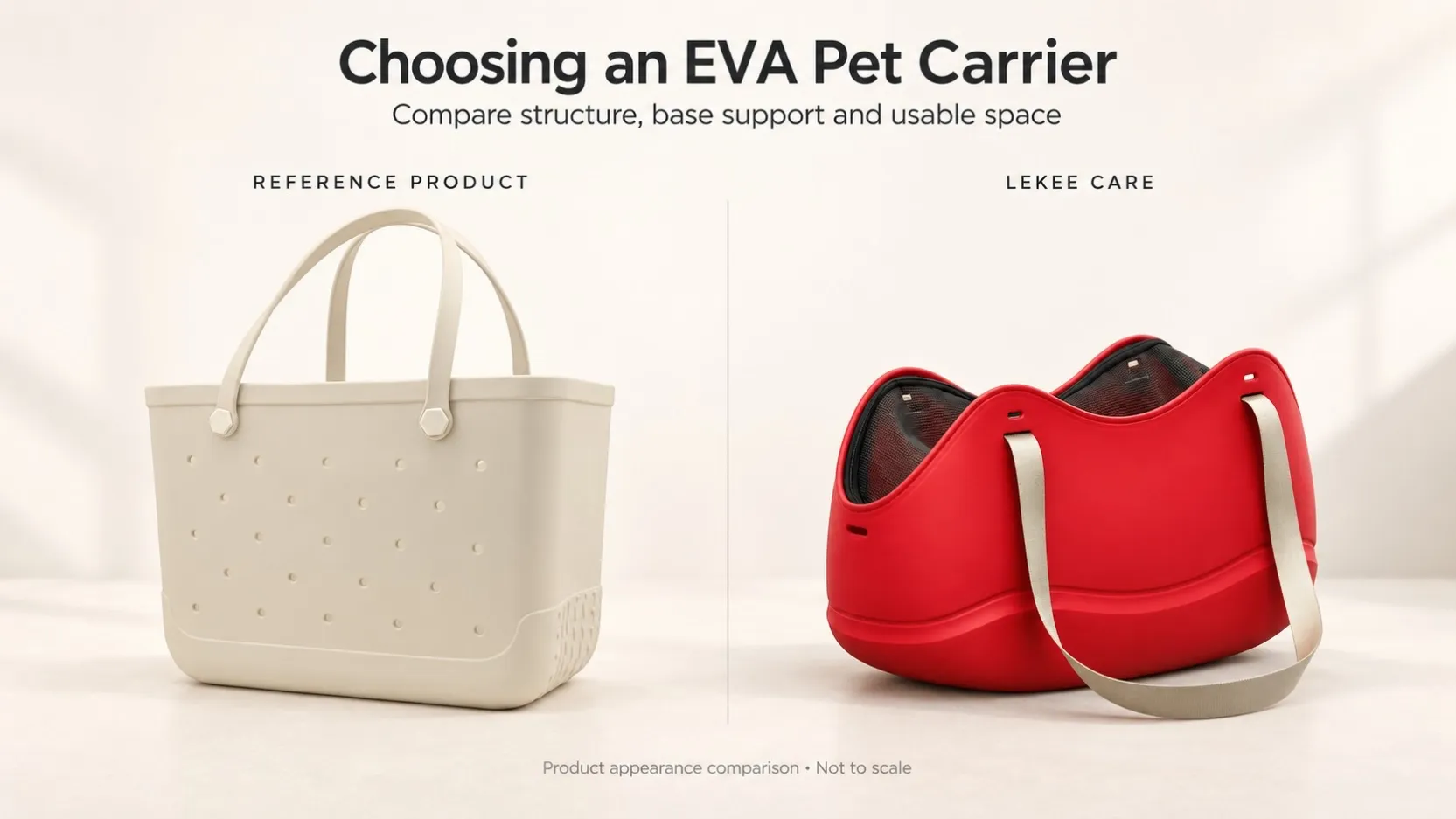
Two EVA pet carriers can look similar in product photos but behave differently when carrying a pet. The material name alone does not explain how well the shell holds its shape, how much the bottom deflects or how much usable space remains inside under load.
For pet brands, importers and private-label buyers, selecting an EVA carrier means comparing the finished structure—not simply choosing a color, size or quoted weight capacity.
The key question is: Does the carrier maintain enough support and internal space during actual use while retaining a comfortably enclosing shape?
The cover is an illustrative product appearance comparison, not to scale. It is not a load test and does not establish the reference product’s manufacturing process or performance. Review physical samples under the same agreed conditions.
1. Start with the Forming Process—not Just the Material Name
One approach to making EVA carrier shells is to cut EVA sheet material and shape it through pressing and forming processes involving heating and cooling.
This approach can offer a lower-cost route to production while retaining EVA’s easy-to-clean surface characteristics. However, softer implementations may provide limited structural support.
A soft shell is not automatically unsuitable. Its suitability depends on the intended use and the complete carrier design. The concern arises when the shell and base deform enough under load to reduce the pet’s usable space.
Buyers should therefore avoid treating “made from EVA” as a complete specification. Ask how the finished shell is formed and how its shape is supported.
The material, forming parameters, shell geometry and bottom construction should be evaluated together.
2. Compare Shape Retention under Load
An empty carrier sitting on a display table does not show how it performs when lifted with weight inside.
A softer shell may look spacious when empty but lean inward or change shape during carrying. If the base also sags, the available floor area and internal clearance can change.
That is why shell support matters beyond appearance: it affects the space available to the pet during use.
In the LeKee Care EVA pet carrier collection, forming parameters are controlled to give the shell a degree of firmness and structural rigidity while retaining an enclosing shape.
The objective is not to make the shell as hard as possible. It is to balance shape retention, support and enclosure.
When reviewing samples, compare:
The empty shape with the loaded shape.
Sidewall movement when the carrier is lifted.
Whether the opening changes shape under load.
Whether the usable internal space becomes noticeably restricted.
How the shell recovers after the load is removed.
Use the same agreed load and carrying conditions for each sample. A hand-squeeze demonstration alone is not a meaningful comparison of carrying performance.
3. Inspect the Bottom: Reinforcement Matters
The base is a critical part of the carrier’s support structure. A shell that feels firm at the sides can still have a bottom that deflects during carrying.
LeKee Care’s EVA carrier design incorporates reinforcing ribs at the bottom. Together with the shell’s controlled rigidity, these ribs are intended to help support the carrying area and preserve room for the pet to reposition inside during use.
This structural feature should be reviewed on a physical sample rather than judged only from external photographs.
Ask the supplier to show:
The bottom structure and reinforcement.
How the base behaves under an agreed distributed load.
The carrier both resting on a surface and suspended by its intended carrying points.
The internal floor with any supplied liner or insert fitted.
Whether the insert is included in the quotation or optional.
Do not assume that a removable cushion provides structural reinforcement. Confirm which component carries the load and which component provides the contact surface.
4. Use a Like-for-Like Comparison
The following comparison describes design tendencies, not a universal ranking of all EVA carriers or a tested comparison of the two products pictured in the cover.
Evaluation point | Softer sheet-formed EVA design | LeKee Care’s structural approach |
|---|---|---|
Cost consideration | Can offer a lower-cost production approach | Compare the quoted cost for the selected model and configuration |
Shell behavior | Softer implementations may deform more under load | Controlled forming parameters provide a degree of firmness and rigidity |
Bottom support | Depends on the specific base design | Reinforcing ribs are incorporated into the bottom |
Internal space during carrying | Deformation may reduce usable space | Structure is intended to help preserve space for repositioning |
Enclosure | Depends on the shell and opening design | Designed to retain an enclosing shape alongside structural support |
Cleaning | EVA surfaces retain their easy-to-clean characteristics | Cleaning assessment should also include mesh, straps, seams and inserts |
Buyer verification | Inspect the complete loaded sample | Inspect the complete loaded sample under the same conditions |
A more supportive design should be demonstrated through sample review. Without a defined test method and results, avoid claims such as “twice as strong,” “no deformation” or “suitable for every pet within the stated weight limit.”
5. Select by Usable Space as Well as Weight
A weight rating does not establish whether a particular pet will fit comfortably.
Buyers should request usable internal dimensions and check how they change with the normal liner, accessories and load in place. External product dimensions are useful for catalog comparison but are not the same as internal space.
LeKee Care’s current model references are:
Model | Listed product dimensions | Listed pet weight limit |
|---|---|---|
KISS / KISS+ | 440 × 240 × 190 mm | Up to 6 kg |
BLOOM | 360 × 200 × 175 mm | Up to 4 kg |
These figures are starting points for selection, not a guarantee of fit. Review the pet’s body dimensions, the opening and the usable interior of the selected model.
Structural support helps preserve the available space; it does not make an undersized carrier suitable for a larger pet.
For product listings, avoid translating a weight limit into a blanket claim that the carrier fits every pet of that weight.
6. Evaluate the Complete Carrier
Shell structure is important, but it is only one part of the purchase decision.
Ventilation and enclosure
Inspect the location and construction of ventilation openings and mesh. Check them with the carrier in its intended use configuration.
Confirm the model-specific closure and cover arrangement. For example, the KISS+ specification includes a mesh cover; buyers should not assume that all models have identical accessories.
Cleaning and maintenance
An easy-to-clean EVA shell does not mean the complete carrier can be cleaned in the same way.
Ask for care instructions covering the shell, mesh, webbing, seams and any removable insert. Confirm which parts can be removed and how they should be dried.
Carrying components
Review handles, straps, buckles and attachment points as part of the complete assembly. A supportive shell should not be used as a substitute for checking the carrying system.
Packaging
Confirm that the packing method does not leave the shell distorted when unpacked. Review an actual packed sample and its recovery after unpacking before approving the final packing arrangement.
7. What B2B Buyers Should Request before Ordering
Ask for a sample and a written specification that identify:
The exact model and included accessories.
Listed external dimensions and usable internal dimensions.
The intended pet weight limit and usage instructions.
Shell construction and bottom reinforcement.
An agreed loaded-sample comparison method.
Care instructions for each material and component.
Branding, color and packaging requirements.
The approved sample reference for bulk production.
For sample charges, eligible sample-fee credits and independent inspection arrangements, see our business FAQ. Specific arrangements are discussed case by case and confirmed in writing.
Frequently Asked Questions
Are all EVA pet carriers structurally similar?
No. The same material description can cover different shell firmness, forming parameters, geometry and base structures. Compare finished samples under the same conditions.
Is a harder shell always better?
Not necessarily. The objective is appropriate support for the intended use, together with suitable internal space, enclosure and a well-designed carrying system. Hardness alone is not a complete quality measure.
What is the purpose of reinforcing ribs at the bottom?
They are a structural feature intended to improve base support. Their practical effect should be reviewed as part of the complete carrier under an agreed load.
Does a stated 6 kg capacity mean every 6 kg pet will fit?
No. Pets of the same weight can have different body dimensions. Confirm usable internal space and the instructions for the selected model.
From Structure Review to a Comparable Quotation
Once the sample structure meets your agreed requirements, record the selected model and accessories before comparing MOQ, branding, packing and delivery scope. Keep physical performance checks separate from the commercial assumptions in the quotation.
Discuss Your EVA Pet Carrier Project
When requesting a quotation, share your target customer, intended use, preferred model, expected pet size range, accessory requirements, order quantity and branding direction.
Explore the LeKee Care EVA pet carrier collection or contact us to discuss samples and OEM/ODM requirements.
A useful comparison goes beyond “EVA versus EVA.” It asks how the finished carrier supports its shape, how the base carries the load and how much usable space remains inside during use.